
Quick answer: If you’re running a WooCommerce store, Hostinger’s Business or Cloud Startup plan is the best overall value for most stores, and SiteGround’s GrowBig plan is the strongest pick if staging and Google Cloud infrastructure matter to you. For larger, established stores that need dedicated managed WordPress support, WP Engine is worth the higher price. If you’d rather not self-host at all, Shopify remains the top hosted platform.
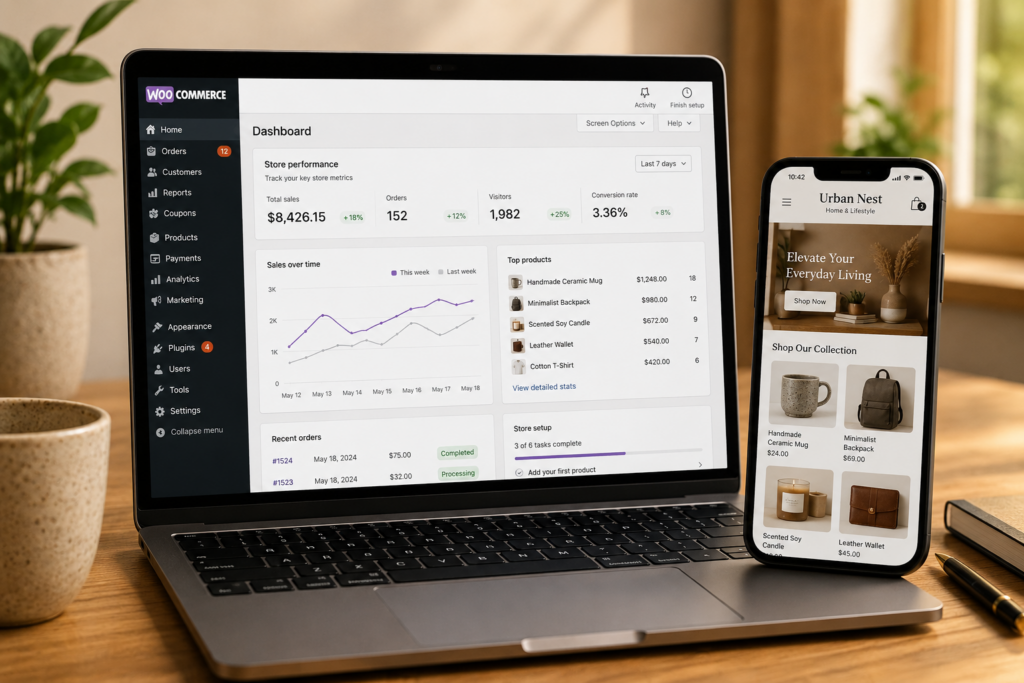
Choosing hosting for an online store is a different decision than choosing hosting for a brochure site. Every product page, cart action, and checkout step runs a database query, which means ecommerce sites are far less “cacheable” than a static page. In 2026, that gap has only gotten wider: stores are adding AI-driven product recommendations, dynamic pricing, and personalized search, all of which put more load on the server with every visitor. The wrong hosting choice doesn’t just mean a slower site; it means lower conversion rates and lost revenue during your highest-traffic moments.
We’ve reviewed the hosting providers that consistently show up as strong options for WordPress and WooCommerce stores in 2026, with an eye on speed, uptime, and how well each one is actually built for ecommerce rather than general websites.
Quick Comparison
| Provider | Best For | Starting Price | WooCommerce Support | Uptime |
| Hostinger | Best overall value | From $3.99/mo (Business), $7.99/mo (Cloud Startup) | Yes, optimized | 99.9% SLA |
| SiteGround | Best for staging & Google Cloud | From $4.99/mo promo (GrowBig) | Yes, pre-installed | 99.9%+ |
| WP Engine | Best for established stores | Contact for pricing | Yes, managed | 99.95%+ |
| Bluehost | Best for beginners | From $14.99/mo (Commerce plan) | Yes, pre-installed | 99.9% |
| Cloudways | Best for scaling cloud infrastructure | From $12/mo (pay-as-you-go) | Yes, via managed stack | 99.9% |
| Shopify | Best hosted platform (no WordPress) | From $39/mo (Basic) | N/A (own platform) | 99.99% |
| Liquid Web | Best for high-traffic managed WooCommerce | From ~$13/mo (intro) | Yes, managed | 100% SLA |
| A2 Hosting | Best for developer control | From ~$12/mo | Yes, via plugins | 99.9% |
Pricing reflects publicly listed rates as of 2026 and often applies to an introductory term before renewal. Confirm current rates on each provider’s site before publishing, since hosting companies adjust pricing frequently.
Top eCommerce Hosting Providers, Reviewed
1. Hostinger
Hostinger has become one of the most recommended hosts for WooCommerce stores in 2026, mainly because it pairs genuinely low pricing with infrastructure that used to be reserved for pricier plans: LiteSpeed servers, AMD EPYC processors, and NVMe storage across the board. For WooCommerce specifically, Hostinger recommends its Business plan for stores under roughly 25,000 monthly visitors and Cloud Startup for anything larger, since Cloud Startup adds dedicated resources and a higher Entry Process limit that prevents the database errors common on shared hosting during traffic spikes.
Features
- LiteSpeed servers with NVMe storage and a Cloudflare CDN
- 99.9% uptime SLA
- Free SSL, weekly or daily backups depending on plan
- hPanel with one-click WooCommerce install
- Kodee AI assistant for automated site health checks and migrations
Pricing: Business plan from $3.99 to $5.99/month depending on term length; Cloud Startup at $7.99/month for higher-traffic stores.
Hosting & VIP Services: “Not sure which Hostinger tier fits your store? Our hosting team can set it up and manage it for you.”]
2. SiteGround
SiteGround remains the strongest pick if you want managed WordPress hosting that treats WooCommerce as a first-class citizen rather than an afterthought. Every WooCommerce-ready plan runs on Google Cloud infrastructure, comes with WooCommerce and the Storefront theme pre-installed, and includes WooCommerce-aware caching that most budget hosts don’t bother configuring correctly.
Features
- Google Cloud infrastructure with multi-layer SuperCacher
- WooCommerce and Storefront theme pre-installed
- Staging environments on GrowBig and above
- AI-based anti-bot protection and a web application firewall
- Daily automatic backups on every plan
Pricing: GrowBig from around $4.99 to $7.99/month on a promotional term, renewing significantly higher (often $24.99 to $29.99/month), so factor renewal pricing into your decision.
3. WP Engine
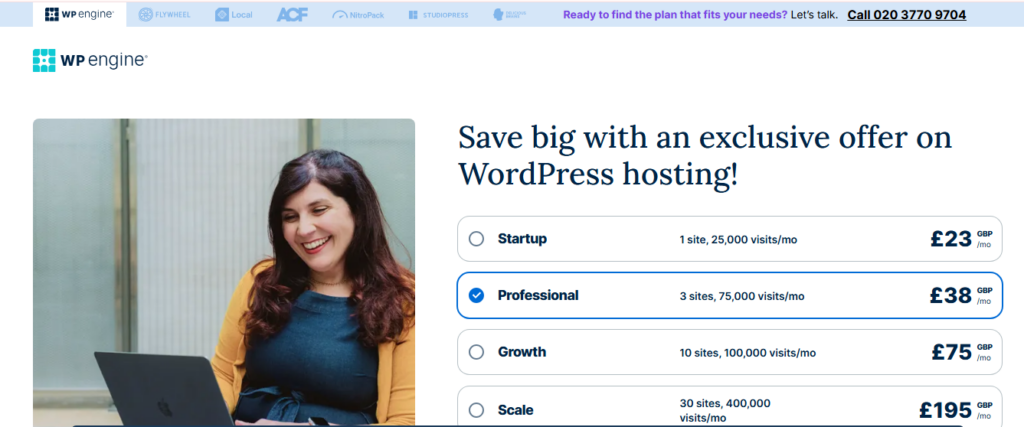
WP Engine is worth including for stores that have outgrown budget hosting. It’s WordPress-only, built specifically around managed performance rather than general-purpose hosting, and partners directly with AWS and Google Cloud to give WooCommerce stores enterprise-level scalability without managing servers yourself.
Features
- Fully managed WordPress and WooCommerce environment
- Built on AWS and Google Cloud infrastructure
- Automatic daily backups and one-click staging
- Advanced security monitoring and threat detection
- Dedicated support familiar with WooCommerce-specific issues
Pricing: Plans are usage-based; contact WP Engine directly for a quote suited to your store’s traffic.
4. Bluehost
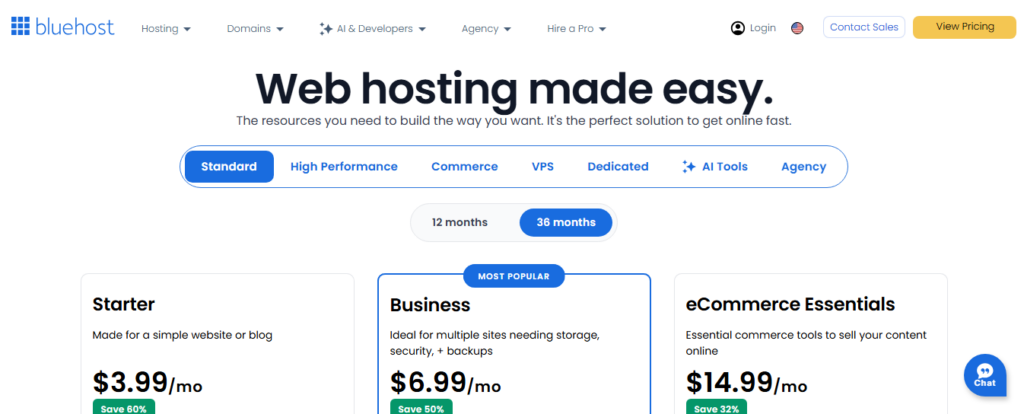
Bluehost is still a reasonable starting point if you want the simplicity of an all-in-one setup: hosting, a free domain, and WooCommerce pre-installed in one signup flow. It’s officially recommended by WordPress.org, and its dedicated commerce plan is built specifically around online stores rather than being a general hosting plan with WooCommerce bolted on.
Features
- WooCommerce pre-installed with guided setup
- Free domain and SSL certificate for the first year
- 24/7 support and automatic software updates
- Free CDN and malware scanning on commerce plans
Pricing: Dedicated commerce plans start around $14.99/month, increasing to roughly $21.99/month after the introductory period.
WordPress Development: “Already have Bluehost hosting sorted? We can build the store itself.”]
5. Cloudways
Cloudways works differently than the others on this list: instead of one fixed plan, you pay for cloud infrastructure (DigitalOcean, AWS, Google Cloud, or Vultr) through a managed layer that handles the server admin for you. This makes it a strong option for stores that want cloud-level scalability without hiring a DevOps person.
Features
- Choice of underlying cloud provider (DigitalOcean, AWS, GCP, Vultr)
- Built-in CDN and object caching for faster page loads
- Free SSL and automated backups
- 24/7 live chat support
- Vertical scaling as traffic grows, without migrating servers
Pricing: Pay-as-you-go, typically ranging from about $12 to $160 a month depending on server size and provider.
6. Shopify
Shopify isn’t a WordPress hosting provider, it’s a fully hosted ecommerce platform, so it belongs on this list as the alternative path rather than a WooCommerce competitor. If a business wants to sell online without managing WordPress at all, Shopify remains the most complete option, with hosting, security, and uptime bundled into the platform itself.
Features
- Fully hosted, no server management required
- Built-in payment processing, shipping, and inventory tools
- Extensive app marketplace for added functionality
- 99.99% uptime track record
Pricing: Basic at $39/month ($29/month billed annually), Grow at $105/month ($79/month annually), Advanced at $399/month ($299/month annually).
7. Liquid Web
Liquid Web’s managed WooCommerce hosting is aimed at stores that need guaranteed uptime and don’t want to think about server management at all. It backs its hosting with a 100% uptime SLA, which is a stronger guarantee than most competitors offer.
Features
- Managed WooCommerce hosting with a 100% uptime SLA
- Choice of cPanel or InterWorx control panel
- Acronis backups and Cloudflare integration
- 24/7/365 support from WooCommerce-trained staff
Pricing: Managed WooCommerce hosting starts at approximately $13 to $14/month on introductory terms; confirm current rate before publishing.
8. A2 Hosting
A2 Hosting is the pick for stores with a developer on hand who wants more control over the server environment. Its Turbo servers are tuned for speed, and it supports one-click installs for WooCommerce alongside more technical options like SSH access.
Features
- Turbo servers for faster page load times
- Free SSL and unlimited email addresses
- Free site migration
- One-click WooCommerce installation
Pricing: Shared plans typically start in the $10 to $15/month range; check current pricing, as A2’s tiers change periodically.
Read Also: Ultimate Guide to Creating Your Website With WordPress
Other Options Worth a Mention
- GoDaddy bundles ecommerce tools like abandoned cart recovery and mobile-optimized checkout, but its WooCommerce optimization lags behind the hosts above.
- HostGator offers an eCommerce plan with unlimited bandwidth, though it isn’t PCI-compliant out of the box.
- DreamHost is a flexible, budget-friendly option with unlimited storage and bandwidth, good for stores that expect to scale gradually.
- Wix and iPage are better suited to non-WordPress stores that want an all-in-one, drag-and-drop setup rather than a WooCommerce build.
Why Hosting Matters More for eCommerce SEO in 2026
Google has been explicit for years that page speed and Core Web Vitals affect rankings, but the stakes are higher for ecommerce now that shoppers expect AI-personalized product recommendations and real-time inventory updates. Those features are dynamic by nature, which means they can’t be fully cached the way a static blog post can. A host that’s fast for a brochure site can still choke on a product page running personalization logic. This is exactly why WooCommerce-specific caching, like SiteGround’s SuperCacher or Hostinger’s LiteSpeed setup, matters more than generic “unlimited bandwidth” marketing claims.
Factors to Consider When Choosing eCommerce Hosting
Performance and Core Web Vitals: Aim for a host with server response times under 600 milliseconds and full page loads under three seconds. Slow product pages increase bounce rates and directly hurt conversions.
WooCommerce-specific optimization: Generic web hosting and WooCommerce-optimized hosting are not the same thing. Look for pre-installed WooCommerce, dynamic caching tuned for cart and checkout pages, and staging environments so you can test changes safely.
Uptime and traffic handling: A store that goes down during a sale event loses revenue in real time. Look for at least a 99.9% uptime guarantee and confirm how the host handles sudden traffic spikes.
Security and compliance: SSL certificates, PCI compliance support, and regular automated backups aren’t optional for a store handling customer payment data.
Support that understands WooCommerce: Generic hosting support often can’t troubleshoot plugin conflicts or checkout errors. Providers with WooCommerce-trained support save you time when something breaks.
Renewal pricing, not just intro pricing: Several hosts on this list use steep introductory discounts that jump significantly at renewal. Budget for the renewal rate, not just the first-year price.
FAQs
Hostinger and SiteGround are the strongest general picks for WooCommerce in 2026, with WP Engine as the upgrade path for larger, established stores that need fully managed support.
Yes. Google factors in site speed, uptime, and security when ranking pages, all of which are directly shaped by your host. A slow or unreliable host can hold back an otherwise well-optimized store.
It depends on how much control you want. Shopify bundles hosting, security, and updates into one platform with less flexibility. WooCommerce on hosting like Hostinger or SiteGround gives you more control over design, plugins, and cost, but requires more hands-on management.
Small stores can start around $4 to $15/month on hosts like Hostinger or SiteGround. Larger stores with high traffic or managed support needs, like WP Engine, often run $50/month and up.
Yes, most hosts offer free migration tools or support, though it’s worth backing up your store fully before switching and testing the migration on a staging site first.
Final Thoughts
The right ecommerce hosting comes down to matching the provider to how your store actually runs, not just picking the cheapest sign-up price. For most WooCommerce stores, Hostinger or SiteGround cover the fundamentals well. As your store grows and traffic gets heavier, moving to a fully managed option like WP Engine or Liquid Web takes the server management off your plate entirely.
If you’d rather not manage any of this yourself, Spinah’s Hosting & VIP Services team can set up, migrate, and manage your WooCommerce hosting for you, and our WordPress Development team can build the store itself once hosting is in place.